How does Business Brokers CRM, think out of the box?

Posted on

Recent Posts

Thinking outside the box

How Does Business Brokers CRM Think Out of the Box?

It started in 2016 with one client's request. Today it settles one of the oldest arguments in a multi-broker firm: when a buyer moves from one listing to another, who introduced them, and who should be paid?
By Joshua Factor, Founder of Vertica CRM • Published • Updated • 10 min read
How Does Business Brokers CRM Think Out of the Box? Tracking who released confidential information to a buyer, and when, in Vertica CRM

Quick answer

Vertica CRM records every release of confidential listing information to a buyer: which listing, which buyer, which broker released it, and the date and time. When a buyer moves between brokers and ends up buying a different listing, that record shows exactly who introduced them, so the firm can apply its commission policy fairly. Common payout options include paying the listing broker only, a fixed referral fee to the introducing broker, an equal split, a three-way split that also credits the broker who registered the buyer, and a time-limited introduction credit.

Most software companies ship a product and tell you to adapt to it. We've always worked the other way around. When a client brings us a problem that no CRM was designed to solve, we think outside the box and build the answer.

This article tells the story of one of those answers. In 2016, a client running a growing multi-broker firm came to us with a simple question that was causing real friction in the office: when confidential information about a listing reaches a buyer, who sent it, and when?

It sounds like a small detail. In practice, it decides who gets paid when a buyer moves from one broker's listing to another's, and it shows exactly which buyers have seen which confidential details. We built a tool to answer it, made it available to every client, and it still works today.

From BBCRM to Vertica CRM

When we first published this article in January 2016, our product was called BBCRM, short for Business Brokers CRM. At the time, it was the only CRM built specifically for business brokers, by people who had worked as business brokers. (From the same era: what was behind BBCRM's success and how buyer registration worked.)

A lot has changed since then. BBCRM grew into Vertica CRM, and the platform has added lead parsing, an integrated document signing tool, AI tools and much more. The data room alone has been upgraded several times. (See how the data room works today.)

What hasn't changed is the release-tracking capability described in this article. Every ability described here is still available in Vertica CRM, and so is the approach behind it: listen to how a brokerage actually works, then configure the system around it.

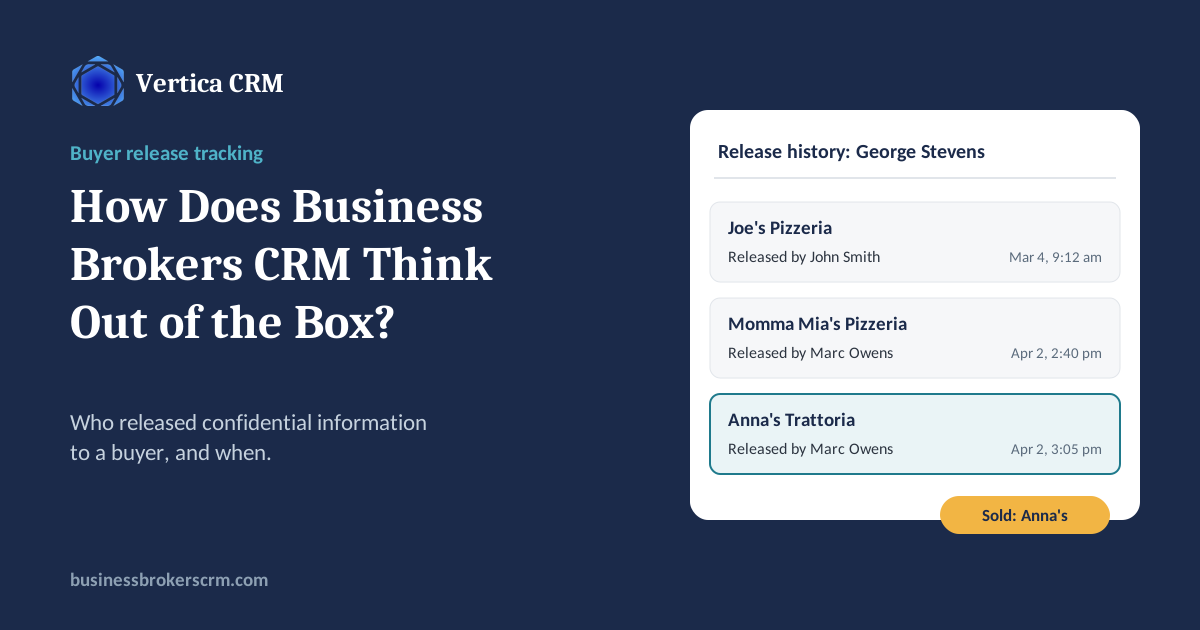
The original 2016 BBCRM screen for tracking which broker released listing information to a buyer, and when
The original 2016 BBCRM release-tracking screen. The data room has been upgraded several times since, and the capability still works as described.

The problem: one buyer, three brokers, three pizzerias

Here's the kind of situation our client described. (All names are fictitious.)

  • John Smith (Broker A) lists Joe's Pizzeria.
  • Marc Owens (Broker B) lists Momma Mia's Pizzeria.
  • David Dalgar (Broker C) lists Anna's Trattoria.

A buyer named George Stevens inquires about Joe's Pizzeria. John registers him, George signs an NDA, and John sends him the confidential details. After reviewing them, George decides that Joe's isn't the right fit.

A few weeks later, George calls the office and reaches Marc. Marc sends him the details of his own listing, Momma Mia's Pizzeria, but George passes on that one too. Then Marc remembers that his colleague David has just listed Anna's Trattoria, and he sends George that information as well.

George loves it. He signs a letter of intent, and the sale closes.

Now the question: who deserves to be paid for the sale of Anna's Trattoria?

David is the listing broker, so he clearly earns a share. But Anna's Trattoria would never have sold to George without Marc's introduction. And John registered George in the first place. Without a record of who released what to George, and when, the answer comes down to memory, and memory tends to favor whoever is telling the story.
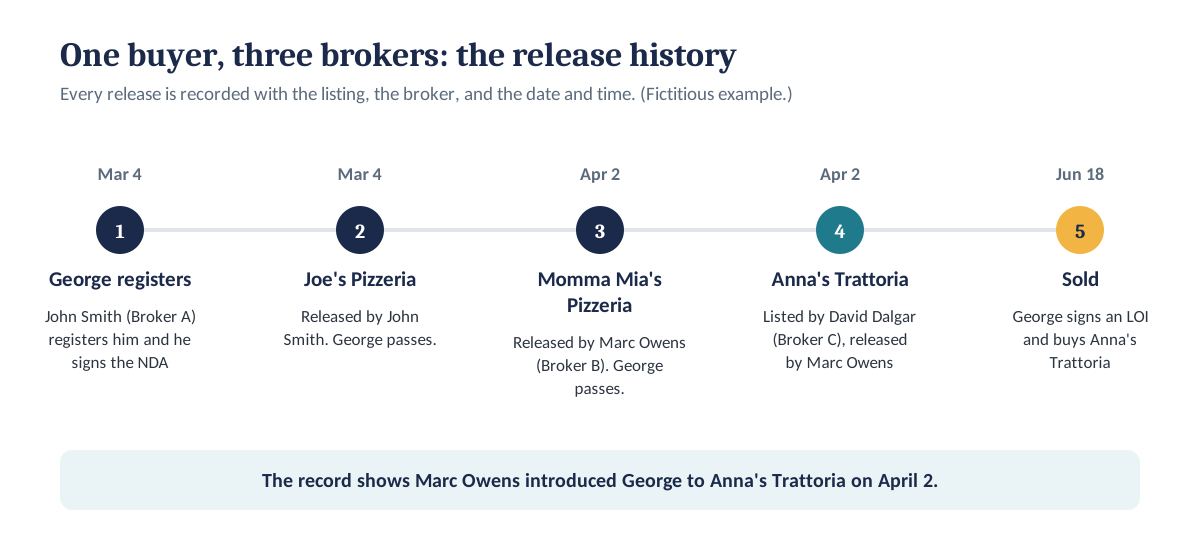
Example release history: George Stevens receives Joe's Pizzeria from John Smith, Momma Mia's Pizzeria from Marc Owens, and Anna's Trattoria from Marc Owens, then buys Anna's Trattoria, listed by David Dalgar
George's release history: every release is recorded with the broker's name and the date and time.

Why it matters who released information, and when

In a one-broker shop, this never comes up. In a firm with several brokers sharing a buyer database, it comes up all the time, and it affects more than commissions.

Fair commission credit

Brokers sometimes call this question procuring cause: whose actions led directly to the sale? A dated record of every release turns an argument into a fact. Everyone can see that Marc introduced George to Anna's Trattoria on a specific day.

Teamwork instead of hoarding

If brokers believe that sharing a buyer means losing credit, they stop sharing. Buyers who would have bought a colleague's listing walk away instead. When introductions are tracked and rewarded, brokers have every reason to send buyers to each other, and deals happen that otherwise wouldn't.

Confidentiality and accountability

A release record also shows which buyers received which confidential details. If a seller asks who has seen their financials, or a confidentiality question comes up later, you have a complete, dated answer. That works hand in hand with your NDA and buyer approval process. (NDA and buyer registration options.)

How release tracking works in Vertica CRM

Release tracking runs in the background. Brokers don't have to log anything; they simply release information the way they normally would.

  1. A broker releases information. A broker sends a buyer the details of a listing, or opens a data room folder to them.
  2. The CRM records the release. Vertica CRM saves the listing, the buyer, the broker who released it, and the date and time.
  3. The buyer moves between listings. Every later release, by any broker on the team, is added to the same buyer's history.
  4. A deal closes. The release history shows who introduced the buyer to the listing that sold.
  5. The firm applies its policy. Commission is paid according to the split rules the firm agreed in advance.

Each release record shows:

  • The listing whose information was released
  • The buyer who received it
  • The broker who released it
  • The date and time of the release

The history sits on the buyer's record, so any broker with permission can see what George has already received before calling him. It works alongside the data room's partial releases, where one folder can open before a letter of intent and post-LOI documents stay locked until you're ready. (Buyer approval and data rooms.) And because every email with the buyer is on the same record, the full conversation is there too. (The contact-specific inbox.)

Commission payout options for buyer introductions

Release tracking tells you who introduced the buyer. Your firm's policy decides what that introduction is worth. There is no single right answer, and every firm sets its own rules. Here are five common approaches, each applied to the same example so you can compare them side by side.

The example

Anna's Trattoria sells for $600,000, and the total commission is 10%, or $60,000. John Smith registered George, Marc Owens introduced him to Anna's Trattoria, and David Dalgar is the listing broker. To keep the math simple, each option splits the full $60,000 among the brokers. In practice, your firm's house share comes off first under your normal agreements.

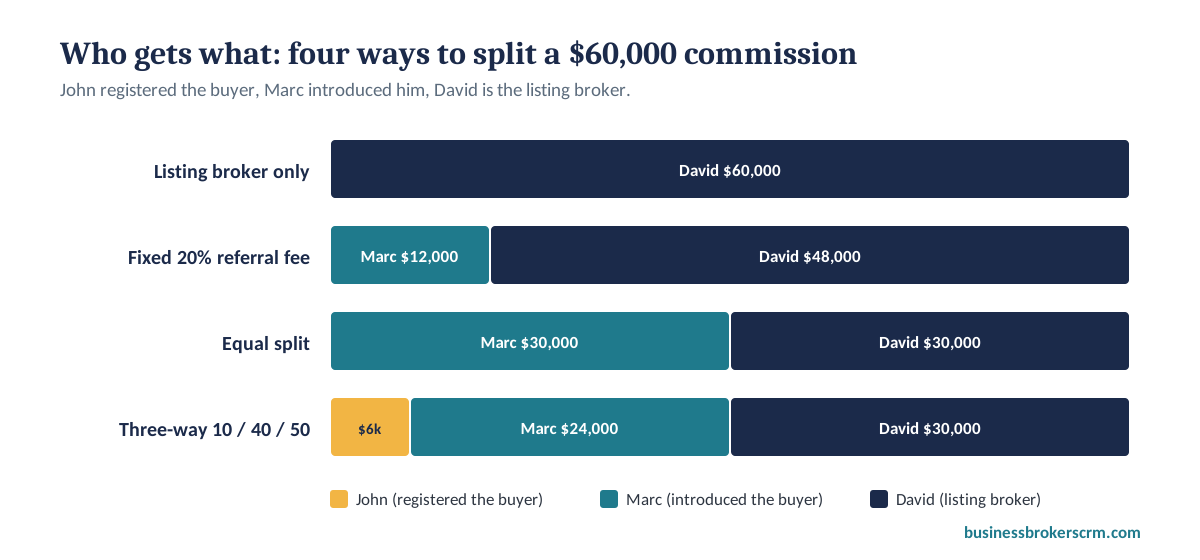
Five ways to pay for a buyer introduction, on a $60,000 commission
OptionJohn (registered)Marc (introduced)David (listing)Best for
Listing broker only$0$0$60,000Small teams where everyone shares buyers anyway
Fixed referral fee$0$12,000$48,000Firms that want a simple, predictable reward
Equal split$0$30,000$30,000Firms that treat finding the buyer as half the work
Three-way split$6,000$24,000$30,000Larger firms where buyers often pass through several brokers
Time-limited creditDependsDependsDependsFirms that want credit to expire if a relationship goes cold
Commission split options on a $60,000 commission: listing broker only, fixed 20% referral fee, equal split, and a 10/40/50 three-way split between the registering, introducing and listing brokers
How the $60,000 commission is divided under the first four options.

Option 1: Listing broker only

The simplest policy. David keeps the full $60,000, and Marc's introduction earns goodwill rather than money. It's easy to administer, but over time it can discourage brokers from sharing buyers.

Option 2: Fixed referral fee

The introducing broker earns a set percentage of the commission. At 20%, Marc receives $12,000 and David $48,000. It's predictable, and brokers know exactly what an introduction is worth.

Option 3: Equal split

The introducing broker receives half of the commission due to the listing broker, so Marc and David each receive $30,000. This is the example the original 2016 article used, and it reflects the view that finding the right buyer is half the work of a sale.

Option 4: Three-way split

The broker who first registered the buyer also earns a credit. With a 10/40/50 split, John receives $6,000, Marc $24,000 and David $30,000. This suits larger firms, where buyers often pass through several brokers before they buy.

Option 5: Time-limited credit

Any of the options above, with one condition: an introduction only earns credit if the buyer signs a letter of intent within a set window after the release, such as 12 months. Because every release is dated, the window is easy to check.

How to choose and document your policy

The worst time to decide how to split a commission is after the deal closes. Agree on the rules first, write them down, and apply them the same way every time.

  1. Decide what counts as an introduction. A release of confidential information is a clear, provable event. A hallway conversation isn't.
  2. Choose a payout option from the list above, or combine them, such as an equal split with a 12-month window.
  3. Decide how ties are broken. If two brokers released the same listing to the same buyer, does the earlier release win?
  4. Put it in writing and include it in each broker's agreement.
  5. Use the record, not memory. When a deal closes, check the release history and pay according to the policy.

The same principle applies to referrals from outside the firm, from accountants, attorneys and other partners. (How to build and measure a referral network.) And Vertica CRM's reporting can show which brokers are generating introductions across the team.

Thinking outside the box, then and now

Release tracking began as one client's request. It became a feature every Vertica CRM client can use, because the problem it solved wasn't unique to that firm. That's how much of Vertica CRM has been built: real brokers bringing real problems.

It's also how we onboard every new client today. We interview each firm, learn its methodology, and configure the system around the way it already works, instead of forcing a round peg into a square hole. Firms that would rather start immediately can use our ready-made business broker processes and automations from day one.

Some of the other answers we've built along the way:

If your firm has a problem no CRM seems to solve, tell us about it. There's a good chance we've solved it before, and if we haven't, we'd like to. (Why brokers abandon CRMs that weren't built for them.) For more on choosing and rolling out a CRM, see choosing and implementing a CRM for your brokerage, why the real value of a CRM isn't the technology, and our CRM comparison for business brokers.

See release tracking on your own team

Tell me how your firm credits buyer introductions, and I'll show you how Vertica CRM can record and apply it.

Schedule a Demo Questions? Call +1 212 381 4994 (USA) or +61 3 8518 4759 (Australia).

Frequently asked questions about buyer release tracking and commission splits

How does Vertica CRM track who released confidential information to a buyer?

Every time a broker releases confidential listing information to a buyer, Vertica CRM records the listing, the buyer, the broker who released it, and the date and time. The history is saved on the buyer's record and the listing, so anyone with permission can see who introduced the buyer to each business.

Who gets the commission when a buyer buys a different listing than the one they first inquired about?

It depends on the firm's policy. Common options are paying the listing broker only, paying the introducing broker a fixed referral fee, splitting the commission equally between the introducing and listing brokers, or a three-way split that also credits the broker who first registered the buyer. A release history shows who introduced the buyer, so the agreed policy can be applied without argument.

What is a fair commission split between brokers in the same firm?

There is no single standard. Some firms pay the introducing broker a fixed percentage, such as 10% to 25% of the commission, while others split it equally with the listing broker. The fairest policy is the one written down and agreed before a deal closes, applied the same way every time.

What is procuring cause in business brokerage?

Procuring cause is the idea that the broker whose actions led directly to a sale deserves the commission. Disputes arise when several brokers worked with the same buyer. A dated record of who released information to the buyer, and when, is the clearest evidence of who introduced them to the business that sold.

Why does it matter who released confidential information to a buyer?

Release records protect sellers and settle disputes. They show which buyers received confidential details and when, which supports NDA compliance, and they show which broker introduced each buyer to each listing, which is the basis for fair commission credit.

Can a data room release only some documents before an LOI?

Yes. Vertica CRM's data room supports partial releases, so a broker can open one folder before a letter of intent and keep post-LOI documents locked until the buyer signs. Each release is recorded with the broker's name and the date and time.

Was this feature built for one client?

It started that way in 2016, when a client asked us to track who released information to each buyer. We made it available to every Vertica CRM client, and it still works as described, even though the data room has been upgraded several times since.

Is BBCRM the same as Vertica CRM?

Yes. BBCRM, also known as Business Brokers CRM, is the original name of Vertica CRM. The product was renamed as it grew, and the same team continues to build it exclusively for business brokers and M&A advisors.