Business Brokerage Technology
The Real Value of a Business Broker CRM Isn't the Technology
NDA automation and AI-drafted CIMs are what you see in a demo. The bigger return shows up somewhere else: in how fast a seller trusts you, whether a deal survives month four, and whether your firm can run without you in the room.
Quick answer
A business broker CRM like Vertica CRM pays off in four ways that don't show up on a feature list. Sellers trust you sooner, because you look and act like an established firm from the first meeting. They worry less during the listing, because they can see what's happening. Deals hold together through the slow middle months. And your brokerage stops depending on what's in your head, so it can grow, take on staff, or one day be sold.
The question that decides a listing
Picture a listing appointment. The owner of a machine shop, twenty-two years in, has given you thirty minutes. He's deciding who to trust with what happens to his business next. You walk in with a legal pad and a solid feel for what the business is worth.
Fifteen minutes in, he asks:
“How do you keep track of who's interested?”
If the honest answer is a spreadsheet and your memory, he'll hear it, however well you phrase it. Three days later he signs with a different firm, one that opened its first meeting with a live dashboard instead of a promise. You weren't less experienced. You just looked less credible in the room.
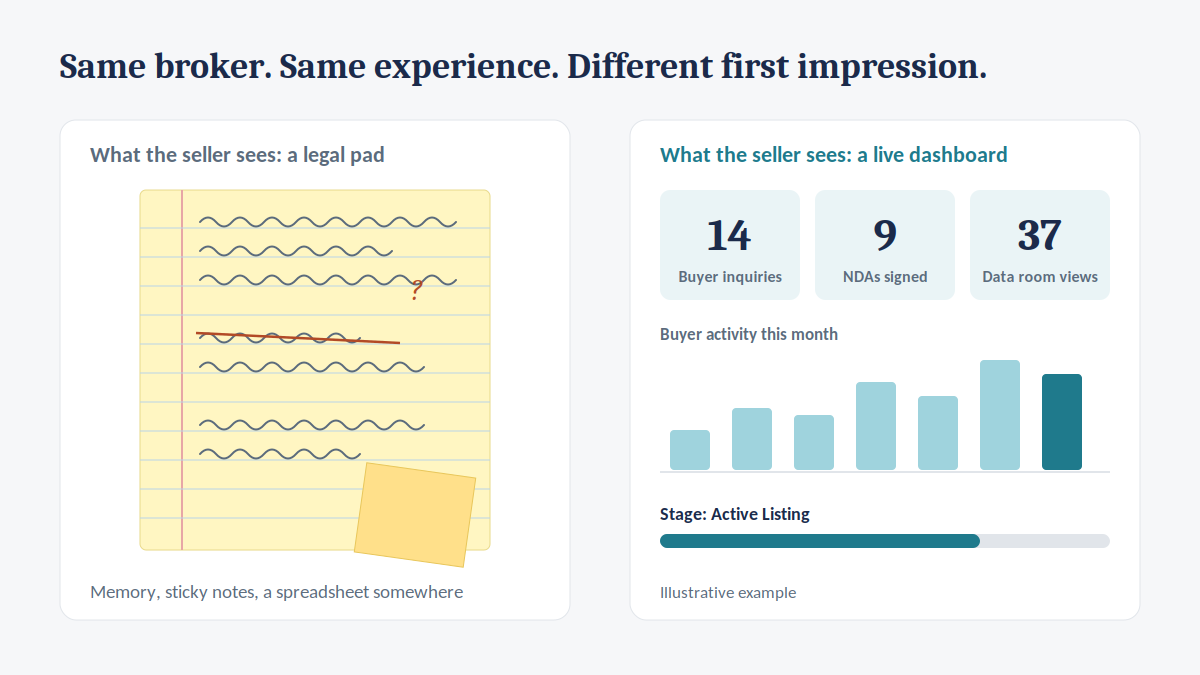
Plenty of good brokers have lost a listing at exactly that moment. I spent years as a business broker before building Vertica, and the features matter: automated NDAs, recasting templates, lead parsing. They're all real and all useful. But the reason they matter has a lot more to do with people than with software, and it comes down to four things that sit underneath every deal.
A business sale isn't a normal B2B deal
For the owner, selling isn't a purchasing decision. It's an emotional, high-stakes event, often the biggest financial decision of their life, and the business is a big part of who they are. They aren't comparing vendors. They're deciding who gets to handle the thing they built.
Read everything below with that in mind. None of it is about the software doing more. It's about what happens to trust, anxiety, momentum and staying power once the routine work is handled well enough that nobody has to think about it.
Beyond the technology itself, a CRM built for business brokers changes your role in four ways.
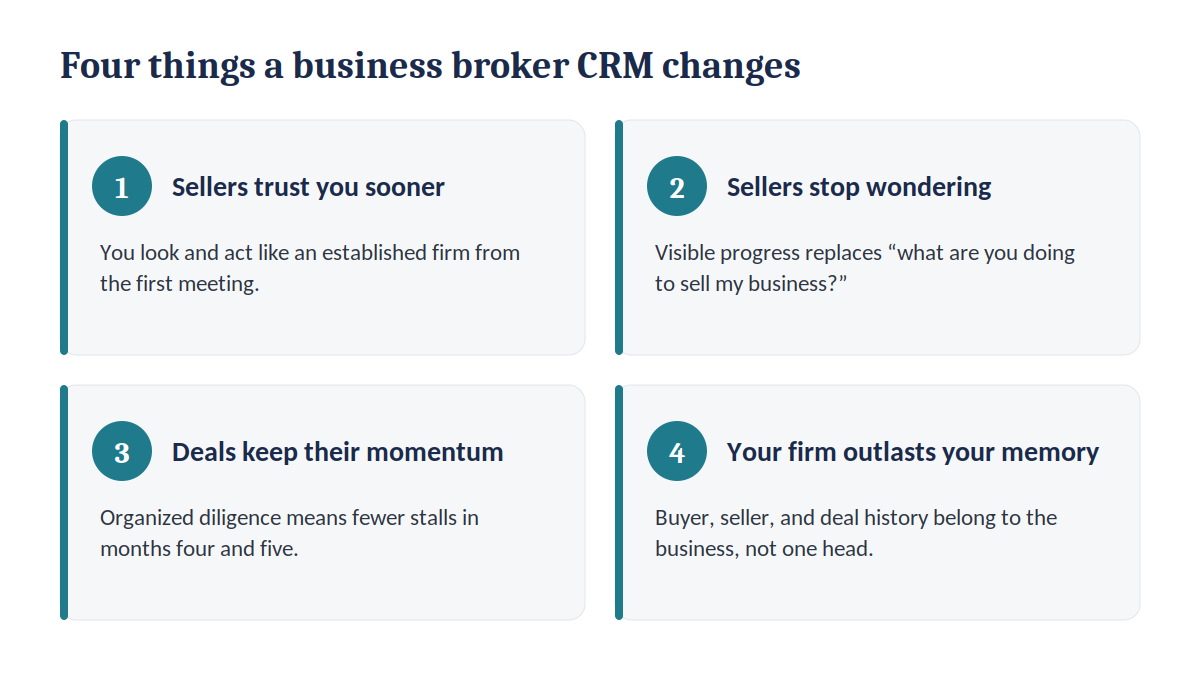
1. Sellers trust you sooner
An owner's biggest fear is handing their life's work to someone who's winging it. A clean SDE report on day one, an NDA process that's clearly under control, an intake that asks the right questions in the right order: none of it is flashy, but together it tells a seller you've done this many times. You come across as an established firm, not a solo operator working from memory.
It changes how you sound, too. When the compliance steps, the due-diligence checklist and buyer vetting are already set up in the background, you aren't juggling them in your head while you talk. You can give the seller your full attention, and they notice.
2. Sellers stop wondering what you're doing
Every broker has heard it: “What are you actually doing to sell my business?” It usually isn't an accusation. It's a seller who can't see anything happening.
When buyer activity, NDA signatures and inquiries are tracked as they happen, and the seller gets regular updates without having to ask, that question mostly goes away. You stop defending your commission and spend that energy advising instead, which is the job they hired you for. (If you want the mechanics, we walk through them in how Vertica CRM takes care of sellers, from first call to referral.)
3. Deals keep their momentum
In my experience, deals tend to wobble around month four or five. Usually nobody did anything wrong. The buyer and seller are just tired: one more document request, one more delay, and somebody starts wondering whether it's worth it.
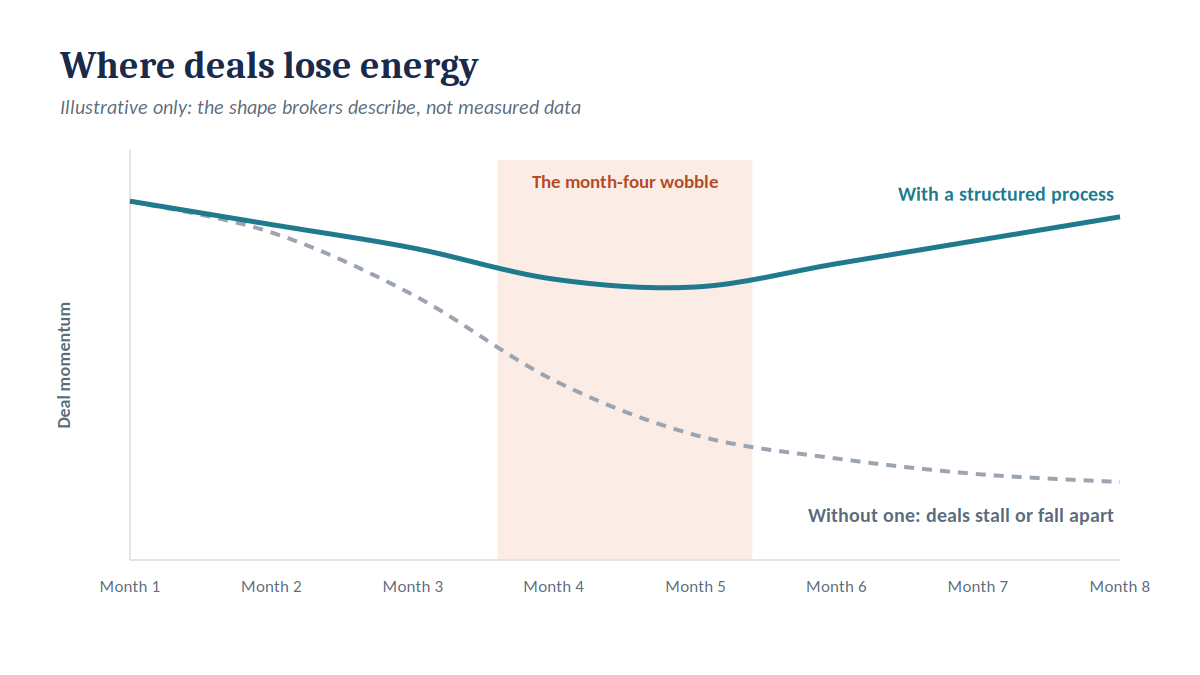
Momentum is what carries a deal through that stretch, and structure protects it. When diligence requests are organized and buyers were vetted properly up front, there are fewer stalls to recover from.
It's easier on you as well. You aren't lying awake wondering whether an LOI deadline slipped or where a signed NDA ended up, so you have more left for the conversations that actually move a deal forward.
4. Your brokerage stops depending on your memory
A lot of brokerages run on one person's memory and a stack of sticky notes. That works right up until that person takes a vacation, gets sick, or wants to retire.
When years of buyer preferences, seller conversations, pricing history and deal notes live in the system, that knowledge belongs to the firm. You can bring on a junior broker or an assistant and trust that your way of doing things is built into the workflow rather than living only in your head.
And if you ever want to sell your own brokerage, one with that history on record is a far easier business to hand over than one that walks out the door with you.
A quick self-check
Five questions worth answering honestly:
- If a seller asked today how many buyers have looked at their listing, could you answer in under a minute?
- Do your sellers hear from you on a schedule, or only when they call?
- Could someone else on your team find every signed NDA for a listing without asking you?
- Do you know which due-diligence items are still outstanding on each deal right now?
- If you were out for two weeks, would your active deals keep moving?
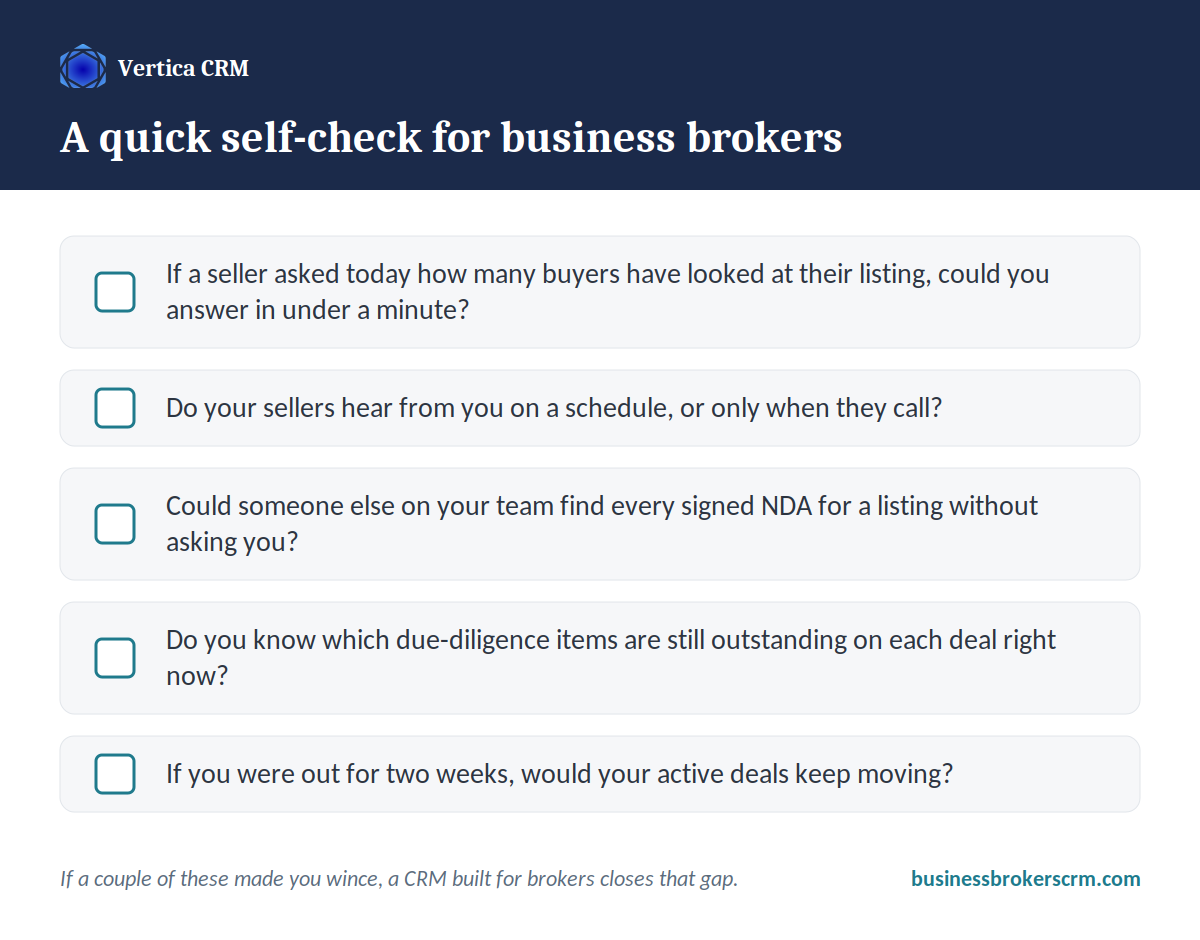
If a couple of those made you wince, you're not alone. That's exactly the gap a CRM built for brokers is meant to close.
What it adds up to
The software keeps track of the data. What you get out of it is time back, sellers who trust you, deals that keep moving, and a brokerage that runs like a firm instead of a one-person scramble.
See it on a real listing
I'll walk you through the seller pipeline, the AI CIM workflow and the buyer tools on a listing that looks like yours. No canned script.
Schedule a Demo Bring your hardest seller question.Frequently asked questions
What is the real value of a CRM for a business broker?
Beyond automated NDAs, financial recasting and lead parsing, a business broker CRM pays off in four ways that don't show up on a feature list. Sellers trust you sooner because you look organized from the first meeting. They worry less during the listing because they can see what's happening. Deals hold together through the slow middle months. And the brokerage stops depending on one person's memory, so it can grow, add staff, or eventually be sold.
How does a CRM help a business broker win a seller's trust?
In a listing appointment, a seller is deciding whether you've done this many times before. A clean SDE report, a controlled NDA process and a structured intake show that quickly. A CRM also takes the compliance, diligence and buyer-vetting steps off your mind, so you can give the seller your full attention.
Why do sellers keep asking their broker for updates?
Usually because they can't see anything happening. When buyer activity, NDA signatures and inquiries are tracked as they happen and the seller receives regular updates without asking, the question 'what are you doing to sell my business?' mostly goes away.
What is deal fatigue in M&A, and how do you prevent it?
Deal fatigue is the exhaustion buyers and sellers feel after months of document requests and delays. It often shows up around the fourth or fifth month of a deal. Organized due diligence and properly vetted buyers mean fewer stalls, which protects the momentum that keeps both sides committed.
Can a business brokerage grow or be sold if it runs on one broker's memory?
It's hard. If buyer preferences, seller conversations, pricing history and deal notes live only in one person's head, the business stops when that person steps away. Keeping that history in a CRM makes it the firm's asset, which supports hiring, delegation and an eventual sale of the brokerage.
Does a CRM make a business broker look more professional?
In practice, yes. Sellers notice organized reports, a controlled NDA process and regular updates. Brokers also tend to come across as calmer and more confident when the routine steps are already handled in the background.
How is this different from Vertica CRM's features?
Vertica CRM's seller pipeline, AI-drafted CIMs and buyer tools are the mechanics. This article is about what using them consistently does for a brokerage: more trust from sellers, fewer anxious calls, deals that keep moving, and a firm that doesn't depend on one person's memory.
Joshua Factor
Founder of Vertica CRM and a former business broker. Vertica CRM has spent 12 years building software exclusively for business brokers and M&A advisors, shaped by feedback from hundreds of brokerage clients.
Related reading
How Vertica CRM Takes Care of Sellers
The seller pipeline, from first call to referral.
Your Brokers Aren't Resistant to Technology
Why brokers abandon their CRM, and what changes when it's built for brokerage.
AI CIM Generator for Business Brokers
How Vertica's native True Context AI drafts a CIM.
The Data Room Advantage
How Vertica CRM runs your deals on autopilot.
Vertica Sign
A document signing tool built for business brokers.
Powerful New Listing Marketing Features
How Vertica CRM handles listing marketing.
Book a demo with the founder
See the seller pipeline running on a listing that looks like yours.