Your Best Listings Come From 20 People: How Business Brokers Build a Referral Network

Posted on

Recent Posts

Referral networks • Part 1 of 2

Your Best Listings Come From 20 People: How Business Brokers Build a Referral Network

Cold outreach and marketplaces fill the top of the funnel. The listings that close smoothly usually come from someone the owner already trusts. Part 1 of this series shows how to build those relationships on purpose: who belongs in your network, where to find them, and how to earn their trust.

By Joshua Factor, Founder of Vertica CRM • Published • Updated • 15 min read
Your best listings come from 20 people: how business brokers build and measure a referral network, from Vertica CRM

Quick answer

Business brokers get their best seller referrals from past clients and from a small group of professionals who already advise business owners: accountants, business attorneys, wealth advisors, bankers, business coaches and exit planners. Build a list of about 20 close referral partners, earn their trust by being visible, credible and helpful, give before you ask, and keep everyone you meet on an automatic follow-up so you're the broker they think of when an owner is ready to sell.

About this series

Part 1 (this article): building your referral network. Part 2: turning those relationships into listings, including past clients, how to ask, what to do when a referral arrives, tracking results and mistakes to avoid. Companion guide: referral fees and co-brokerage agreements.

A senior broker I spoke with recently runs his whole seller pipeline on one number: twenty.

He keeps a list of 20 professionals who send him business. Accountants, a few attorneys, a wealth manager, two business coaches. He has coffee with five of them every month. And once a year he sits down with the numbers and asks a blunt question about each one: did this relationship send me anything?

“If I have twenty good ones, I'll get ten to twenty leads a year. So every year I keep the top ten, and I go find ten new ones.”

That is not a marketing campaign. It is a system, and it is one most brokers never build, because it is easier to leave referrals to luck. This two-part series shows how to build it on purpose, with a free scorecard template and ready-to-use scripts to get you started.

Where referrals come from: a lot of handshakes

When I started brokering businesses, my career was built on shaking hands. A lot of hands. I drove up and down every road in my county and beyond, walked into every business on every street, and met the owners and their employees. Everyone got my business card and a brochure. My message to each owner was simple: put my card away for five years, and when you're ready to sell, give me a call.

Sometimes an owner would say, “Sorry, I'm not interested. Please leave.” And sometimes those very same owners would chase after me on my way out and ask for a confidential meeting to value their business. They had only thrown me out so their employees would see they weren't thinking about selling.

Let me tell you a secret: almost every business owner is thinking about selling their business.

I couldn't follow up with hundreds of owners by hand, so almost every one of them went onto a drip campaign, and I would forget about them until they were ready. The campaign followed up for me automatically, at set intervals, for as long as it took. Today, Vertica CRM can run custom drip campaigns for every scenario in your methodology. (How drip campaigns keep relationships warm.)

Then the referrals start

The first few years of a brokerage practice are usually the hardest. Life is like that: all beginnings are difficult. But after a few years of hard work prospecting and closing deals, I noticed my practice changing. More and more of my business came from referrals, and I had less and less time to prospect. I took it as a sign that I was moving up in the industry.

Suddenly, sellers were coming to me, and I had more seller leads than I could handle. That's when I started handing some of the smaller leads to junior colleagues. (How to share referrals across a team.)

Today, you don't have to knock on every door yourself. Vertica People sales development representatives can prospect for seller leads and new referral partners on your behalf while you focus on closing. (More on getting help in Part 2.)

That's the real promise of a referral network. The handshakes and follow-up of your early years compound into a pipeline that comes to you. If you do things right and you have the proper tools, you are going to be successful. The rest of this series shows how to build that network on purpose, so it happens sooner and doesn't depend on luck.

From handshakes to referrals: a business broker's journey from door-to-door prospecting and drip campaigns in the early years to referrals that bring sellers in, and handing smaller leads to junior colleagues
How a referral practice grows: handshakes and follow-up first, referrals later.

Why referrals are different from every other lead source

A marketplace inquiry starts cold. A referral starts warm, because someone the owner trusts has already vouched for you. That changes almost everything about the conversation:

  • Trust arrives with the introduction. The owner is meeting “the broker my accountant recommends,” not a stranger who called out of the blue.
  • The timing is often right. Advisors hear about health scares, partner disputes, burnout and succession gaps long before an owner calls a broker.
  • The owner is better prepared. A referred owner usually has cleaner books and a clearer reason to sell, because their advisor has been helping them think about it.
  • Referrals compound. A partner who sees you treat their client well sends the next one faster.

The research backs this up:

  • People trust people they know. In Nielsen's 2021 Trust in Advertising study, 88% of respondents said they most trust recommendations from people they know.
  • Referred clients are worth more. A Wharton study published in the Journal of Marketing found that referred customers had about 18% lower churn and roughly 16% higher lifetime value than comparable customers who weren't referred.
  • Brokers say so too. When the IBBA (International Business Brokers Association) and M&A Source asked brokers where their best new client came from in their Q3 2012 MarketPulse survey, 55% said a referral. Asked about their best client in the previous three months, 31% named a referral from a past client and 21% named a referral from an accountant.

Sources: Nielsen, Trust in Advertising, 2021; Schmitt, Skiera and Van den Bulte, “Referral Programs and Customer Value,” Journal of Marketing, 2011; International Business Brokers Association (IBBA) and M&A Source, MarketPulse Survey Report, Third Quarter 2012.

Here is how referrals compare with the other ways brokers find sellers:

How seller lead sources compare for business brokers
Lead sourceHow the conversation startsOwner's trust at first contactOngoing costWhat it takes
Advisor referralsA warm introduction from someone the owner already trustsHighMostly your timeA defined partner list and a meeting rhythm
Past clientsThe owner knows your work, or knows someone who doesHighLowStaying in touch after the deal closes
Website and SEOThe owner finds you while researching a saleMedium: they chose to contact youContent and site upkeepUseful articles and an easy way to reach you
Paid adsThe owner responds to an adLow to mediumSpend for every leadBudget, testing and fast follow-up
Cold calls and direct mailYou contact the owner firstLowLists, postage and timeVolume and persistence

The other sources still matter, and where your next listing comes from covers them in detail, along with why every broker needs a website and how SEO builds trust. Referrals are the lead source you can build deliberately, one relationship at a time.

What the referral experts teach

Some of the best thinking on referrals comes from outside business brokerage. Three ideas translate especially well:

Bob Burg: know, like and trust

In Endless Referrals, sales author Bob Burg puts it simply: all things being equal, people will do business with, and refer business to, people they know, like and trust. For a broker, that means a partner has to know you exist, enjoy working with you, and be confident you won't embarrass them in front of their client. Burg's advice is to get to know people before you need anything from them, ask questions and listen, and be consistent.

Ivan Misner: visibility, credibility, profitability

Ivan Misner, founder of the networking organization BNI, describes referral relationships as farming, not hunting. They grow through three stages he calls VCP: visibility, when people become aware of you; credibility, when you keep appointments and deliver on promises; and profitability, when the relationship rewards both sides. Most brokers try to jump straight to the third stage. The 20-referrer system is built to move each partner through all three.

John Jantsch: your clients aren't your only talkers

In The Referral Engine, marketing author John Jantsch argues that referrals come from a wider circle than customers: strategic partners, employees and even competitors. He also found that businesses with strong word of mouth use technology to deepen personal relationships, not to replace them. That is exactly the balance a broker needs: automation to stay in touch with hundreds of people, and coffee meetings with the twenty who matter most.

We'll come back to the art of asking, including advice from referral coach Bill Cates, in Part 2.

Who belongs in your referral network

The best referral partners are people who see an owner's finances, family situation or plans before anyone else does. Each type sees sellers at a different moment, and each wants something different from you.

Accountants and CPAs

Accountants are usually the strongest source. They see the numbers every year, and they are often the first person to hear an owner say “I'm tired” or “I've had an offer.” What they want from you: a broker who won't embarrass them, who explains the tax side of a sale clearly, and who sends their clients back to them afterward. Open with an offer to help their clients, such as a rough sense of value for an owner who is “just curious,” not a request for referrals.

Business and estate attorneys

Attorneys draft partnership agreements, buy-sell agreements, wills and trusts, so they see succession problems early, including the ones the owner hasn't faced yet. They want a broker who understands deal structure and keeps the transaction clean enough that their work goes smoothly. A good opening is a short conversation about what happens when a buy-sell agreement is triggered and no one knows what the business is worth.

Wealth managers and financial planners

For many owners, the business is most of their net worth, and their planner is waiting for the day it becomes cash to manage. Planners want to know a sale is likely, roughly what it could bring, and when. Offer to help them with clients whose retirement plan depends on selling the business, and keep them informed once a client is in the process.

Bankers and SBA lenders

Lenders work both sides of your market. They know which owners are reaching the end of their loans or planning their next step, and they need well-prepared buyers and well-documented businesses for acquisition loans. Send them qualified buyers and clean financial packages, and they will think of you when a borrower mentions selling.

Business coaches and exit planners

Their whole job is getting owners ready for a transition, so their clients are often closer to a sale than anyone else's. They want a broker who respects the planning work they have done and doesn't rush their client. Agree early on how you will work together, and keep them in the loop.

Insurance agents and commercial real estate brokers

They talk to owners about leases, key-person insurance and buy-sell funding. They are a lighter-touch source, but useful: a lease renewal or a key-person policy review often prompts the question of what happens to the business next.

Other business brokers

Out-of-area or out-of-niche brokers can send you deals they can't take, and co-broker the ones they can. (How to make co-brokering easy.)

Specialize, and become easy to refer

Advisors refer to specialists. “I sell businesses” is hard to remember. “I sell manufacturing companies in Ohio” or “I sell pharmacies and pharmaceutical businesses” is easy to repeat to a client. A clear niche makes every partner's job easier, and it gives your website and articles something specific to rank for.

Aim for a mix. Three accountants and no attorneys means one kind of conversation is reaching you and others are not. In Vertica CRM, you can tag each partner by type, so your list, and the gaps in it, are always one click away.

Where to meet new referral partners

Your first 40 candidates will come from people you already know. After that, you need new names. These are the places brokers most often meet the professionals who advise owners:

  • Professional associations. State CPA society chapters, bar association business and estate planning sections, and local estate planning councils.
  • Business groups. Chambers of commerce, Rotary and industry associations in your niche.
  • Referral networking groups. BNI and similar groups exist specifically to exchange referrals, usually with one member per profession.
  • Exit planning communities. Exit planning and succession planning groups bring together the advisors closest to owners who are preparing to sell.
  • Lender events. SBA lending events and bank business-development meetings.
  • Broker associations. The IBBA, M&A Source and state broker associations connect you with other brokers for co-brokering and out-of-area referrals.
  • Teaching. A short talk on how business sales work, for a CPA firm's staff or a chamber audience, introduces you to a room full of potential partners at once.

In Vertica CRM, everyone you meet goes into one database, and the contact-specific inbox attaches every email you exchange with them, including past emails that are still on your mail server. New names can go straight onto a drip campaign until you're ready to meet. (Drip campaigns for referral partners.)

How partners check you out before they refer

Before an accountant sends you a client, they will look you up. So will the client. What they find decides whether the introduction happens:

  • Google reviews. A steady stream of recent reviews from sellers and buyers is the first thing many people check.
  • Testimonials. Short written or video testimonials from past clients, ideally from the same kind of business the partner advises.
  • Your LinkedIn profile. A clear headline that states your niche, recent posts, and recommendations from other professionals.
  • Your website. A professional site with your niche, your process, recent articles and an easy way to make an introduction.

In Vertica Sites, our website and marketing platform, you can collect and display testimonials, including video testimonials, publish articles with built-in SEO tools, and add a partner referral form that sends introductions straight into Vertica CRM. (See how Vertica Sites works.)

The 20-referrer rule

Why 20? Because it is small enough to know every person well, and large enough to produce a steady flow. Most brokers who rely on referrals have a few names they think of as “good sources.” Very few have a defined list, and fewer still know how much each person on it has actually produced.

Start wider, then narrow down:

  1. List 40 candidates. Every professional who has sent you a client, worked on one of your deals, or advises owners in your niche.
  2. Score them on two questions. How many business owners do they advise in your market? And how strong is your relationship today?
  3. Pick your 20. Favor people with many owner clients, even if the relationship is new. You can build a relationship. You can't create an advisor's client list.
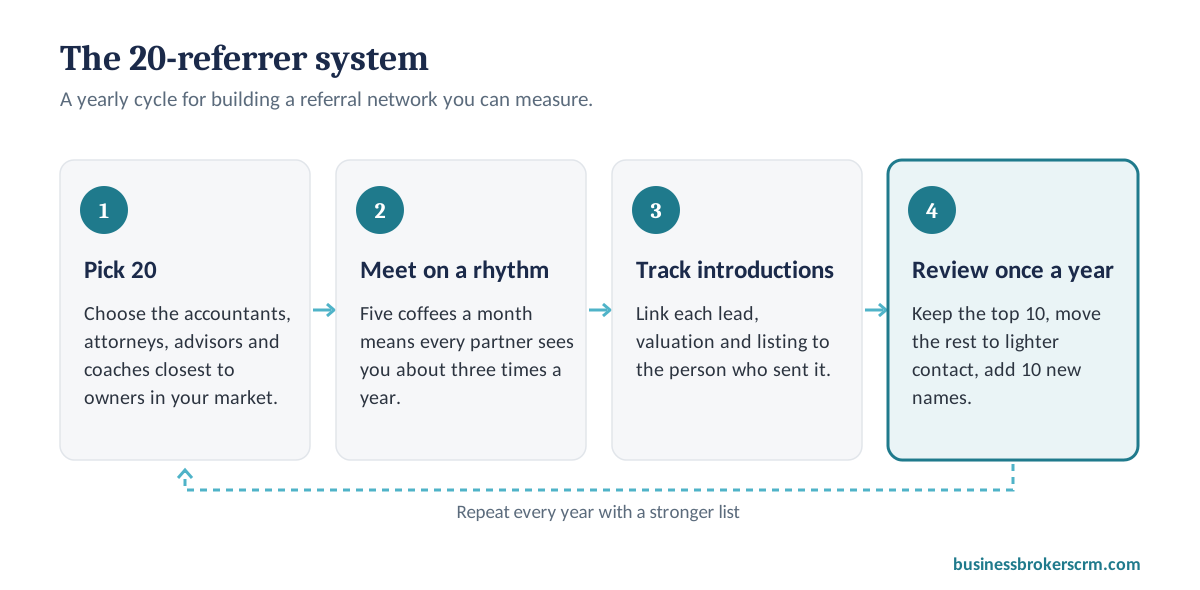
The 20-referrer system for business brokers: pick 20 referral partners, meet on a rhythm, track introductions, and review once a year, keeping the top 10 and adding 10 new names
The 20-referrer system: a yearly cycle you can measure.

Picking the list is Part 1. Running it, with a meeting rhythm, tracking and an annual review, is Part 2.

Free download: Referral Partner Scorecard

A ready-made Excel workbook for the whole cycle: a 40-name candidate list that scores and ranks itself, a 20-partner scorecard, a 12-month meeting planner and an annual review sheet that sorts your top 10 automatically. Download the Referral Partner Scorecard.
Give before you ask

The strongest referral relationships go both ways. Bob Burg's Go-Giver principle sums it up: your true worth is determined by how much more you give in value than you take in payment. Advisors refer to the broker who makes them look good to their clients, and who sends business back:

  • Refer your buyers and sellers to them. Every buyer needs an accountant and an attorney. Every seller needs tax and estate advice.
  • Offer to teach. A short talk on how business sales work, for an accounting firm's staff or a lender's team, puts you in front of everyone at once.
  • Share credit. When a referred deal closes, tell the partner what their introduction led to.
  • Be generous. Where a referral fee is allowed, don't be greedy. Partners remember brokers who treat them well, and keep them in mind for the next referral. (Referral fee guide.)
  • Remember what matters to them. A note on a partner's birthday, or on the anniversary of a deal you closed together, is a reason to get in touch that has nothing to do with asking for business.

In Vertica CRM, the Relationships tab links each partner to the clients you share, whether they referred them to you or you introduced them, so giving and receiving are both on the record. Workflows can remind you, create a task, or send an email or text message on birthdays and closing anniversaries.

Next: turning relationships into listings

You now have a list, a place to find new names, and a way to earn trust. Part 2 of this series covers what turns those relationships into signed listings, and our companion guide to referral fees and co-brokerage agreements covers the rules for paying partners:

See your referral network on your own pipeline

I'll show you how Vertica CRM finds the referral partners already in your email history, links every introduction to the person who sent it, and builds your yearly referral report for you.

Schedule a Demo Questions? Call our office at +1 212 381 4994.

Frequently asked questions about referral networks

How do business brokers get referrals?

Most seller referrals come from past clients and from professionals who already advise business owners, such as accountants, attorneys, wealth advisors, bankers, coaches and exit planners. Brokers get more of them by building a defined list of referral partners, meeting each one regularly, sending useful market updates, referring business back, and keeping every contact on an automatic follow-up.

Who are the best referral sources for business brokers?

Past clients and accountants are usually the strongest. In an IBBA and M&A Source MarketPulse survey, 31% of brokers said their best recent client came from a past-client referral and 21% from an accountant referral. Business and estate attorneys, wealth managers, SBA lenders, business coaches, exit planners and other brokers are also strong sources.

How many referral partners should a business broker have?

A focused list of about 20 close referral partners is enough to produce a steady flow of introductions while still letting you know each person well. Review the list once a year, keep the top 10 and replace the partners who have not produced.

Where can business brokers meet referral partners?

Good places include state CPA society chapters, bar association business and estate planning sections, estate planning councils, chambers of commerce, BNI and similar referral groups, exit planning groups, SBA lender events, and broker associations such as the IBBA and M&A Source.

Are referred clients more valuable?

Research suggests so. A Wharton study published in the Journal of Marketing found that referred customers had about 18% lower churn and roughly 16% higher lifetime value than comparable customers who were not referred, and Nielsen found that 88% of people most trust recommendations from people they know.

How long does it take a business broker to start getting referrals?

The first few years are usually the hardest, because most new business comes from prospecting. After a few years of prospecting, staying in touch and closing deals, many brokers find that more and more of their business comes from referrals from past clients and advisors. Drip campaigns that follow up automatically, and a defined referral network, help speed that up.

What are the stages of a referral relationship?

Networking expert Ivan Misner, founder of BNI, describes three stages he calls VCP: visibility, when people become aware of you; credibility, when you consistently keep promises and deliver; and profitability, when the relationship rewards both sides. Referrals usually start to flow only once a partner reaches the credibility stage.

What do referral partners look for before referring a broker?

Partners want a broker who won't embarrass them. Before referring, they typically check Google reviews, testimonials, the broker's LinkedIn profile and website, and whether the broker specializes in their client's type of business.