From Handshake to Listing: How Business Brokers Ask for, Track and Grow Referrals

Posted on

Recent Posts

Referral networks • Part 2 of 2

From Handshake to Listing: How Business Brokers Ask for, Track and Grow Referrals

A referral network only pays off when relationships turn into introductions, and introductions turn into signed listings. Part 2 covers the moments that decide it: staying in touch with past clients, asking without being pushy, handling every referral well, and measuring what each partner produces.

By Joshua Factor, Founder of Vertica CRM • Published • Updated • 15 min read
From handshake to listing: how business brokers ask for, track and grow referrals, Part 2 of 2

Quick answer

To turn relationships into referrals, stay in touch with past clients after every closing, ask specifically for introductions at the right moments, respond to every referral the same day and keep the referring partner informed, thank partners every time, and track every introduction back to the person who sent it. Review the results once a year, keep the partners who produce, and keep everyone else warm with automatic follow-up.

About this series

Part 1: building your referral network, including who belongs in it, where to meet partners and how partners check you out. Part 2 (this article): turning those relationships into listings. Companion guide: referral fees and co-brokerage agreements.

Picture this. On a Friday afternoon, an accountant you had coffee with last spring emails you: one of her clients, the owner of a $3 million HVAC company, is thinking about selling. You're busy, so you plan to call on Monday. By Monday, the owner has already met another broker, one his attorney mentioned the same week.

The relationship worked. The introduction happened. The listing still went somewhere else.

In Part 1, we covered how to build a referral network: the handshakes, the right partners, and the trust that makes people want to refer you. This part is about the moments that turn those relationships into signed listings, and the system that makes sure you never miss one.

Your best referral source: past clients

Advisors get most of the attention, but your own past clients may be your best source of all. When the IBBA and M&A Source asked brokers about their best client in the previous three months, the largest group, 31%, named a referral from a past client. (Source: MarketPulse survey, Q3 2012.)

Past clients know your work first-hand. A seller you guided through a smooth sale tells other owners at their industry association. A buyer you helped acquire a business may want to buy another one, or sell this one in five years. The relationship doesn't end at closing; it changes shape.

  • Stay in touch after closing. A note at 30 days, a call at six months, and a message on the anniversary of the closing.
  • Ask happy clients for a review or testimonial while the experience is fresh, and for introductions to other owners they know.
  • Treat buyers as future sellers. Every buyer who acquires a business through you is a potential listing later.
  • Keep them in your database for good. Owners move, change roles and buy again. A past client you've stayed in touch with will call you first.

In Vertica CRM, a past-client drip campaign keeps every seller and buyer you've worked with on a schedule of useful, personal touches, and a workflow can remind you, create a call task, or send an email or text message on each closing anniversary. (More on how Vertica CRM takes care of sellers, from first call to referral.)

The past-client referral cycle for business brokers: close the deal, stay in touch after closing, ask for a review and introductions, mark closing anniversaries, and receive referrals, with buyers becoming future sellers
Past clients: the referral source most brokers neglect after closing.

How to ask for a referral

Many brokers build good relationships and then never ask. Referral coach Bill Cates, author of Get More Referrals Now, teaches that you can ask for referrals without begging or pushing, and that the real goal is not a name and a phone number but a personal introduction. Ivan Misner makes a similar point: the more specific the ask, the easier it is to answer. (More from the referral experts in Part 1.)

When to ask

  • Right after a success. A smooth closing, a strong valuation, or a problem you solved for the partner's client.
  • When someone thanks you. “I'm glad it went well. Who else do you know who might be thinking about the future of their business?”
  • At your regular meetings with partners, once the relationship is built, not at the first coffee.

How to ask

  • Be specific. “Do you know anyone who might want to sell?” is easy to say no to. “Do any of your clients own manufacturing businesses and plan to retire in the next few years?” brings a name to mind.
  • Ask for an introduction, not a phone number. A short email from the partner to both of you is worth ten cold calls.
  • Make it easy. Offer to draft the introduction email for them, or give them a link to a referral form on your website.
  • Protect them. Promise to treat their client with care, keep everything confidential, and send the client back to them for tax and legal advice.

Our referral partner scripts include a ready-made introduction email and a phone script for asking. In Vertica Sites, a partner referral form on your website sends each introduction straight into Vertica CRM, already linked to the partner who made it. (See how Vertica Sites works.)

What to do when a referral arrives

How you handle a referral decides whether you get the next one. Partners are trusting you with their reputation, and they will notice what happens next.

  1. Respond the same day. Speed shows respect, and, as the Friday story shows, a slow response can cost you the listing.
  2. Thank the partner right away, whether or not it turns into business.
  3. Keep the partner informed at each milestone: first meeting, engagement, going to market, closing. Respect confidentiality, and share only what the client is comfortable with.
  4. Send the client back to the partner for the advice they give.
  5. If it isn't a fit, still handle it well. Hand smaller deals to a junior colleague, or refer the owner to someone who can help, and tell the partner what you did.
  6. Close the loop. When the deal closes, tell the partner what their introduction led to.

In Vertica CRM, a referral from your website form becomes a seller lead linked to the referring partner automatically. An automation can assign the lead to the right broker, create a same-day follow-up task, and send the partner a thank-you. As the seller moves through your stages, a workflow can create a thank-you task or send the partner a short update when the seller signs an engagement, goes to market or closes, so partners hear what their introduction led to every time.

What to do when a referral arrives: respond the same day, thank the partner, keep them informed at each milestone, send the client back for their advice, and close the loop when the deal closes
Handle every referral well, and partners keep sending them.

A meeting rhythm you can actually keep

Referral relationships fade without contact. The fix is a rhythm small enough to survive a busy month. Five coffees, lunches or calls a month is 60 meetings a year. Spread across the 20 partners you chose in Part 1, that is about three conversations with each one every year, without ever feeling like a second job.

Between meetings, stay in front of them with something useful:

  • A short quarterly market update. What businesses are selling for in your area, how long deals are taking, what buyers are asking for.
  • A quick opinion when they need it. Partners value a broker who will give a rough sense of value for a client who is “just curious.”
  • A thank-you after every introduction, whether or not it turns into a listing.
  • A note on the days that matter to them, such as a birthday or the anniversary of a deal you closed together.

In Vertica CRM, meetings can be scheduled as recurring tasks that sync with your Outlook or Google calendar, with reminders so no partner goes quiet. The quarterly update goes out as a campaign to your partner list, and you can see who opened and clicked it. If even five coffees a month is hard to schedule, Vertica People can book the meetings and send the update for you.

Keep every relationship warm with drip campaigns

Not every relationship needs a coffee. The owners who told you “not yet,” the partners on lighter contact, the 40 candidates who didn't make your top 20: all of them deserve to hear from you, regularly, without you having to remember. That's what drip campaigns are for. As I described in Part 1, almost every owner I met went onto one.

In Vertica CRM, you can build custom drip campaigns for as many scenarios as your methodology needs:

  • Owners you met in person who aren't ready to sell yet
  • Sellers who had a valuation but decided to wait
  • Referral partners on lighter contact, between the meetings you reserve for your top 10
  • Past clients, sellers and buyers alike
  • New contacts you met at an association event

Each campaign follows up automatically at the intervals you choose, and Vertica CRM tracks email opens, clicks and reads, and even when a contact views a page on your website, such as a new listing. When someone starts paying attention, you'll know it's time to call. (Why follow-ups lead to fortunes.)

Measure what each partner actually produces

This is the step most brokers skip, and it is the one that makes the system work. If you don't record where each lead came from, the annual review turns into a popularity contest: you keep the people you like, not the people who send you business.

Track five numbers for each partner:

  • Meetings you had with them this year.
  • Introductions they made to owners.
  • Valuations that came from those introductions.
  • Listings signed.
  • Fees closed.
Example referral scorecard (illustrative numbers)
Referral partnerTypeMeetingsIntroductionsListingsFees closed
Partner ACPA firm462$148,000
Partner BEstate attorney331$62,000
Partner CWealth manager340$0
Partner DBusiness coach210$0
Partner ESBA lender300$0

Read the scorecard together, not one column at a time. Partner C has sent four introductions and no listings yet. That may mean the relationship needs a conversation about who is a good fit, not that it should end.

In Vertica CRM, you link each seller lead to the partner who sent it, and the partner's Relationships tab shows every client they have referred. Introductions, listings and fees roll up to the partner, and the referral report shows results by partner, so you never rebuild the scorecard by hand. Prefer a spreadsheet to start? Use the free Referral Partner Scorecard.

The annual review: keep the top 10, rotate the rest

Once a year, sort the list by what each partner produced and make three decisions:

  • Keep your top 10. These are your core relationships. Protect the meeting rhythm with them above everything else.
  • Move the bottom 10 to lighter contact. They go onto a drip campaign and still get the quarterly update. Nobody gets dropped, and some will surprise you next year.
  • Add 10 new names from your candidate list, and start the rhythm with them.

Over three or four years, this rotation turns an ordinary contact list into a network of people who genuinely send you business. Vertica CRM's reporting turns the review into a ten-minute job.
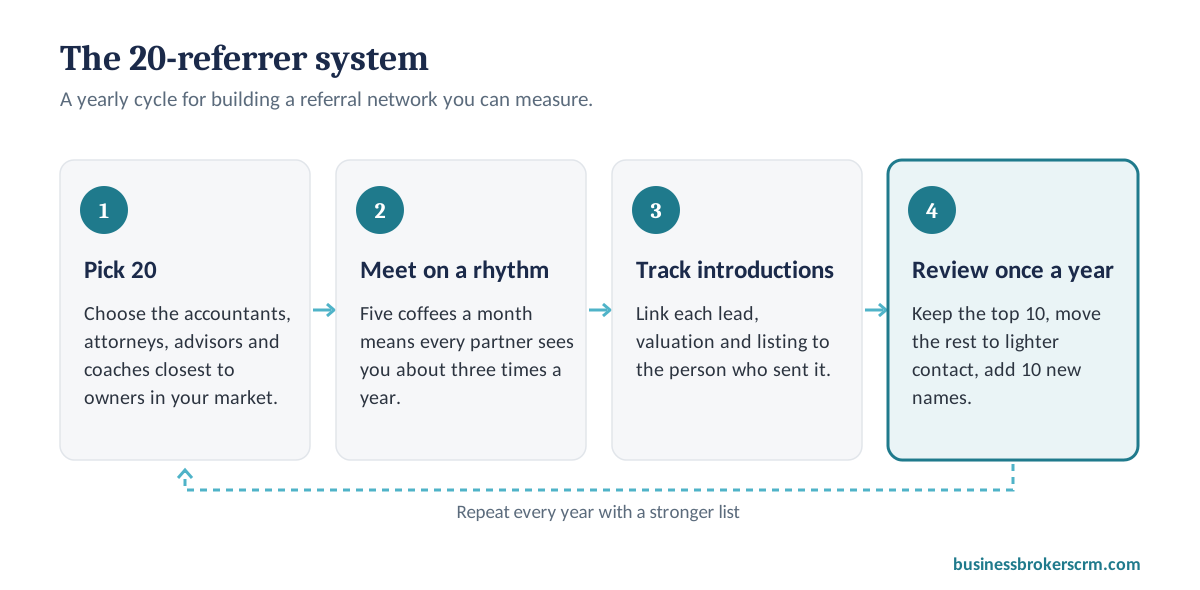
The 20-referrer system for business brokers: pick 20 referral partners, meet on a rhythm, track introductions, and review once a year, keeping the top 10 and adding 10 new names
The yearly cycle: pick, meet, track, review.

Widen the circle: other brokers

Other brokers belong in your network too. Out-of-area or out-of-niche brokers can send you deals they can't take, and co-broker the ones they can, and paperwork shouldn't slow a shared deal down.

In Vertica CRM, when someone inquires about one of your listings and selects “I am a broker,” the system can send a co-brokerage agreement instead of the usual buyer NDA. (NDA and buyer registration options.) For any other agreement, such as a referral or fee-split agreement, you can send a Vertica Sign template for e-signature in one click from the partner's contact record, and the signed copy is saved back to that record. Out-of-area deals you pass along, and the ones that come back to you, are recorded on that broker's contact. (What to put in a co-brokerage agreement.)

A word on referral fees

Once a partner is sending you business, the question of paying them usually comes up. The short answer is that it depends on who the partner is and where you both work, and the rules are stricter than many brokers expect:

  • Accountants who accept a referral fee must disclose it to the client in writing under the AICPA Code, and can't take commissions tied to clients whose financial statements they audit or review.
  • Attorneys generally can't share legal fees with non-lawyers or accept anything of value for a recommendation, though non-exclusive, disclosed reciprocal referral arrangements are often allowed.
  • Unlicensed people, such as a friend or past client, often can't be paid at all in states where business brokerage requires a real estate license. Texas, for example, bars license holders from paying unlicensed people for referrals beyond small gifts.
  • Other licensed brokers can usually share a fee, ideally under a written agreement signed before the deal.

When a fee is allowed, don't be greedy. In my experience, about 20% to 30% of the fee is a good range for a referral, depending on the relationship, and a reputation for being generous with partners pays you back many times over in future referrals.

This is not legal advice. For the full rules, including state licensing, securities considerations on stock sales and what to put in a written agreement, see our companion guide to referral fees and co-brokerage agreements. In practice, the strongest referral networks run on reciprocity, good service and gratitude, not payments. In Vertica CRM, you can send a fee-split or co-brokerage agreement for e-signature in one click from the partner's contact record using a Vertica Sign template, and the signed copy is saved to that record.

Need more hands? Let Vertica People prospect for you

Building a referral network takes time, and so does everything around it: finding new partners, booking meetings, following up with past clients and filling the pipeline while referrals ramp up. If you don't have the hours, you don't have to do it alone.

Vertica People provides trained sales development representatives (SDRs), lead generation and administrative support for business brokers. Your Vertica People team can:

  • Generate seller leads with outbound prospecting, so your pipeline keeps moving while your referral network grows.
  • Find and reach new referral partners, such as accountants, attorneys and wealth managers in your market, and book introductory meetings on your calendar.
  • Run your follow-up, from the quarterly update to past-client touches and drip campaign replies.
  • Handle the admin that eats into your selling time, working directly inside Vertica CRM so every call, email and meeting is on the record.

It's the modern version of shaking every hand on every street, with a team doing the legwork and you doing the closing. (Learn how Vertica People helps brokers close more deals.)

One referral network for the whole team

In a firm with several brokers, the same CPA often knows three of you. Without a shared record, two brokers book coffee with the same partner in the same week, or one sends a message that contradicts another's.

  • One shared history. With every email on the partner's record in the contact-specific inbox, anyone can see who spoke to them last and what was said.
  • Fair credit. When a buyer or seller moves between brokers, Vertica CRM records who introduced them and when. (How release tracking settles who gets credit.)
  • Room to grow. When referrals bring in more seller leads than you can handle, assign the smaller ones to junior colleagues, with the full history going with each lead. That's exactly how I grew my own practice.
  • Control. The permission system decides who can see which relationships.

Common referral mistakes to avoid

Most referral networks don't fail for lack of effort. They fail because of a few habits:

  1. Asking too soon. Asking for referrals at the first coffee skips the credibility stage. Build the relationship first.
  2. Only calling when you want something. Partners notice. Give first, and stay in touch between asks.
  3. Asking vaguely. “Let me know if you hear of anyone” rarely produces a name. Be specific about who you help.
  4. Responding slowly. A referral that waits until Monday can go to another broker.
  5. Forgetting to thank and update. Partners who never hear what happened stop referring.
  6. Neglecting past clients. The people who know your work best hear from you least.
  7. Not tracking the source. Without records, you can't tell who actually sends you business.
  8. Letting the list go stale. Without an annual review, the same unproductive relationships take up your time year after year.

Once a listing is signed, a different set of risks takes over. Here's how to keep deals from falling apart before closing.

Your first 30 days

  1. Week 1: Download the scorecard, list 40 candidates and score them. Your email history is a good place to start. (The 20-referrer rule.)
  2. Week 2: Pick your 20 and tag them in your CRM. Put everyone else, including past clients, on a drip campaign.
  3. Week 3: Book your first five meetings, using the first-email scripts.
  4. Week 4: Link your current seller leads to the partners who sent them, add a referral form to your website, and send your first quarterly update.

A year from now, you'll have your first scorecard, and you'll know exactly who your best 10 are.

See your referral network on your own pipeline

I'll show you how Vertica CRM finds the referral partners already in your email history, links every introduction to the person who sent it, and builds your yearly referral report for you.

Schedule a Demo Questions? Call our office at +1 212 381 4994.

Frequently asked questions about asking for and tracking referrals

How should a business broker ask for referrals?

Ask at the right moment, such as after a successful closing or when someone thanks you, and be specific about who you help, for example owners of manufacturing businesses planning to retire. Ask for a personal introduction rather than a phone number, make it easy by drafting the introduction email, and promise to protect the partner's relationship with their client.

How do business brokers get referrals from past clients?

Stay in touch after closing with a note at 30 days, a call at six months and a message on each closing anniversary, ask happy clients for reviews and introductions, and treat buyers as future sellers. A past-client drip campaign in a CRM keeps every former client on a regular schedule of personal touches.

What should you do when you receive a referral?

Respond the same day, thank the referring partner right away, keep them informed at each milestone while respecting confidentiality, send the client back to them for their advice, and tell them what their introduction led to when the deal closes. If the referral isn't a fit, still handle it well and let the partner know.

What is a drip campaign for business brokers?

A drip campaign is a series of messages sent automatically at set intervals to a group of contacts, such as owners who aren't ready to sell, sellers who had a valuation, referral partners on lighter contact, or past clients. Vertica CRM supports custom drip campaigns for each scenario in a broker's methodology.

How can I thank referral partners automatically?

Use a CRM workflow tied to the referred seller's stage. When the seller signs an engagement, goes to market or closes, the workflow can create a thank-you task or send a short note to the partner who made the introduction. Workflows can also remind you, or send an email or text, on a partner's birthday or a closing anniversary.

How do you track referral sources in a CRM?

Tag each referral partner as a contact, link every seller lead to the partner who sent it, and report on introductions, valuations, listings and closed fees by partner. A referral form on your website that is connected to the CRM links new leads to the right partner automatically.

Should business brokers pay referral fees?

It depends on who receives the fee and where. CPAs who accept referral fees must disclose them to the client in writing under the AICPA Code, attorneys face bar rules on fee sharing, and some states prohibit paying referral fees to unlicensed people. Fee splits between licensed brokers are common and best agreed in writing before the deal. Check with your counsel first.

What are the most common referral mistakes business brokers make?

The most common mistakes are asking too soon, only calling when you want something, asking vaguely, responding slowly, forgetting to thank and update partners, neglecting past clients, not tracking where referrals come from, and never reviewing the partner list.

Is there a free referral tracking template for business brokers?

Yes. Vertica CRM's free Referral Partner Scorecard is an Excel workbook with a 40-name candidate list, a 20-partner scorecard that tracks meetings, introductions, valuations, listings and fees, a 12-month meeting planner and an annual review sheet.

From Handshake to Listing: How Business Brokers Ask for, Track and Grow Referrals