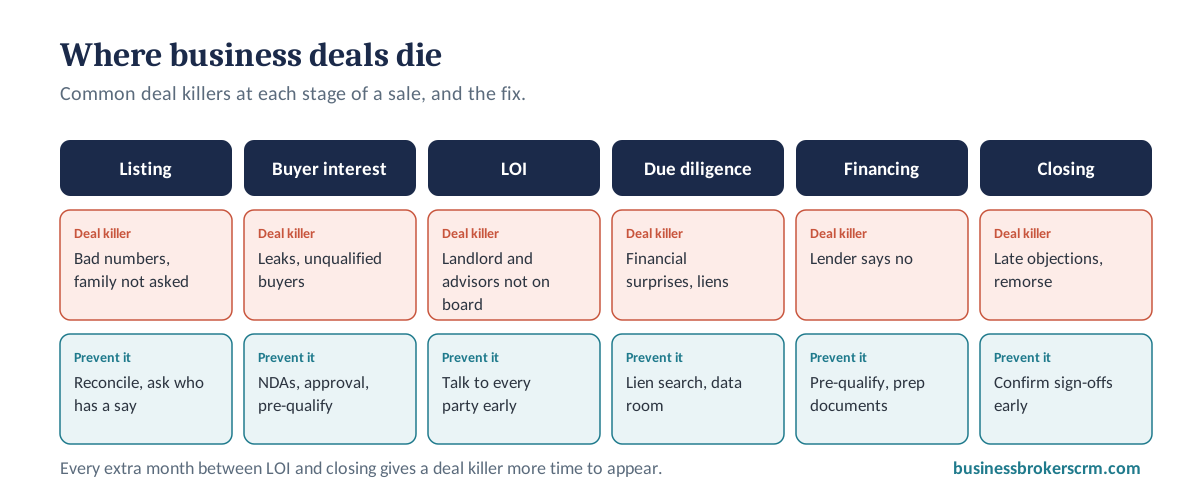
THE MANY BUSINESS DEAL KILLERS (AND HOW TO AVOID THEM)

Posted on

Recent Posts

Closing deals

The Many Business Deal Killers (and How to Avoid Them): 10 Reasons Business Sales Fall Apart

Most business sales don't die at the closing table. They die months earlier, quietly, when nobody is watching the right people. Here are the ten most common deal killers, the warning signs, and how business brokers keep deals alive.
By Joshua Factor, Founder of Vertica CRM • Published • Updated • 13 min read
The many business deal killers and how to avoid them: why business sales fall through, from Vertica CRM

Quick answer

The most common business deal killers are a landlord who won't assign the lease, attorneys or accountants who raise objections late, family members or silent partners who oppose the sale, hidden liens and debts, financials that don't hold up in due diligence, financing that falls through, a business that underperforms during the sale, renegotiation, and deals that drag on until someone walks away. Brokers prevent most of them the same way: identify every person who can say no, talk to each one early, check debts and financials before the LOI, and track every step and conversation so nothing surprises you at closing.

Picture a broker named Tom Lloyd, working on only his second deal. It's a big one, with a commission that would make his year. After months of back-and-forth over the wording of the purchase agreement, everyone finally gathers at the seller's attorney's office to sign.

Then the buyer's attorney clears his throat.

“I've advised my client not to go ahead. It's just a bad deal.”

Tom asks whether there's a specific problem, a term they could fix. There isn't. The attorney simply doesn't like the deal. When Tom points out that he could have said so months ago, before everyone spent all that time and money, the attorney shrugs and admits that might have been better.

Tom is fictional, but if you've been a business broker for any length of time, you've probably had a Tom moment of your own. Deals rarely die because of one dramatic event at the closing table. They die because someone who could say no was never brought into the conversation, or because a problem was sitting in plain sight and nobody checked.

As Joshua Factor, founder of Vertica CRM, puts it after 24 years combined in business brokerage and software for brokers: “Every deal has enemies. Some are people, like a family member who doesn't want the business sold or a landlord who won't sign the lease. Some are problems nobody knew about, like a lien. Most of them can be found early if you know where to look.”

A broken handshake representing a business sale that falls apart before closing
Most deals that fall apart at closing were in trouble long before anyone sat down to sign.

How often business sales fall through

Deal killers aren't rare. The research is sobering:

  • Most businesses that go to market never sell. According to the Exit Planning Institute, only 20% to 30% of businesses that go to market actually sell.
  • Signed LOIs still fall apart. In Axial's Dead Deal Report, an analysis of 65 lower middle market deals that broke after a signed letter of intent in 2024, the top causes were diligence findings (21.5%), quality of earnings discrepancies in EBITDA (15.4%), failure to secure financing (13.8%), business underperformance (12.3%) and renegotiation (10.8%).
  • Deals take time, and time is risk. In the IBBA and M&A Source Market Pulse survey for Q4 2025, completed by 350 business brokers and M&A advisors, businesses typically took six to 12 months to sell, with roughly three to four months of due diligence after a signed LOI.
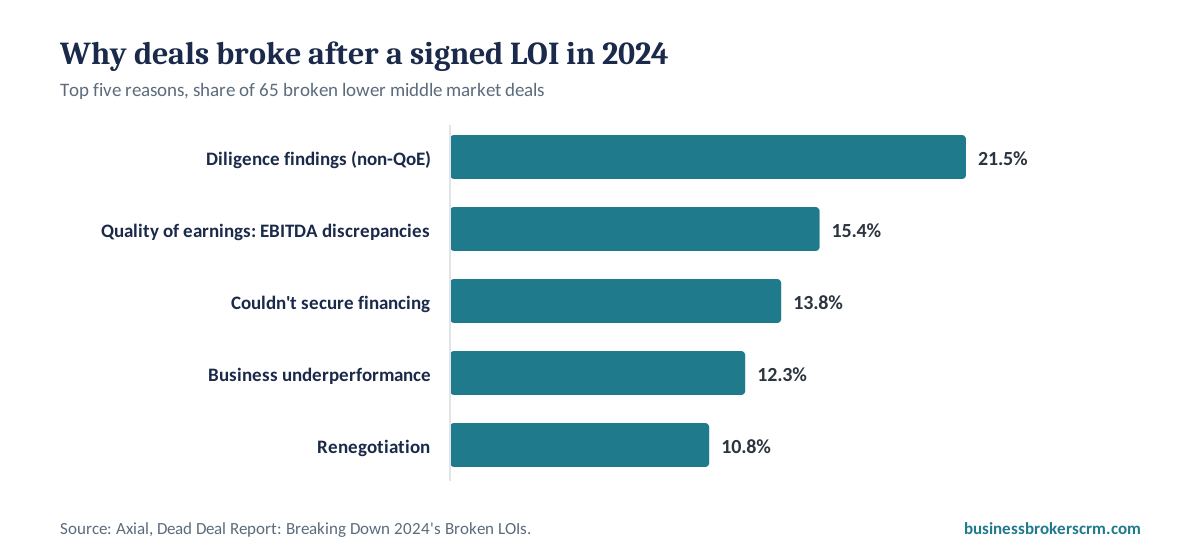
Top reasons lower middle market deals broke after a signed LOI in 2024, per Axial: diligence findings 21.5%, quality of earnings EBITDA discrepancies 15.4%, financing 13.8%, business underperformance 12.3%, renegotiation 10.8%
Why lower middle market deals broke after a signed LOI in 2024.

Sources: Exit Planning Institute, State of Owner Readiness research; Axial, Dead Deal Report: Breaking Down 2024's Broken LOIs; International Business Brokers Association (IBBA) and M&A Source, Market Pulse Survey, Q4 2025.

The good news is that most of these causes can be spotted early. Here are the ten deal killers business brokers see most often, the warning signs, and what to do about each one.

The 10 most common business deal killers, and how to avoid them

1. The landlord

For most small businesses, the lease is the deal. Landlords hold both the figurative and the literal keys: if they won't assign the lease to the buyer, or they use the sale as a chance to raise the rent, the buyer may walk.

Warning signs: the lease expires soon, it doesn't allow assignment, the landlord is slow to respond, or the seller hasn't spoken to them in years.

How to prevent it: read the lease when you take the listing. Speak to the landlord directly, early, and confirm whether they will assign the lease or sign a new one, and on what terms. Don't let a buyer fall in love with a business before you know the location comes with it.

2. Attorneys who object late

Good attorneys protect their clients. But an attorney who has doubts and keeps them quiet until closing day can undo months of work in a sentence.

Warning signs: an attorney who isn't returning drafts, keeps reopening settled points, or hasn't been told the timeline.

How to prevent it: make sure the attorneys on both sides support the deal from the start, and ask directly whether they have concerns. Get objections on the table while they can still be solved, not at the closing table, as Tom learned.

3. Accountants and financial advisors

A buyer's accountant or financial advisor is often cautious by nature. Their job is to protect the client's money, and the easiest way to do that is to say no.

Warning signs: the buyer keeps saying “my accountant needs to look at it,” or a financial advisor is worried about how much of their client's money is going into the business.

How to prevent it: bring the buyer's advisors in early. Give them clean financials and the information they need to evaluate the deal on its merits. An advisor who understands the business is far less likely to recommend walking away.

4. Family members and silent partners

A son who expected to inherit the business, a spouse who wasn't consulted, or a partner with a small stake can all stop a sale. So can a seller who isn't emotionally ready.

Warning signs: the seller mentions a spouse, a child who works in the business, or an investor from years ago, or the seller seems unsure about letting go.

How to prevent it: ask the seller at the first meeting who else has a say, or an opinion, about the sale. Bring those people in early. And remember that sometimes the person who needs reassurance is the seller, so keep checking in on how they feel about life after the sale.

5. Hidden liens and debts

Imagine discovering at closing that the seller owes six years of back property taxes, more than the price of the sale. Liens and debts surface late because nobody looked early.

Warning signs: unpaid taxes, equipment loans, merchant cash advances, or a seller who is vague about what the business owes.

How to prevent it: run lien, judgment and tax searches early, and ask the seller to disclose every debt in writing. Find out who has to be paid at closing, and make sure the sale price covers it.

6. Financials that don't hold up in due diligence

This is the single biggest category in Axial's data. When a buyer's due diligence or quality of earnings review finds different numbers, trust disappears and the price usually follows.

Warning signs: add-backs the seller can't document, cash revenue that isn't recorded, or tax returns that don't match the profit and loss statement.

How to prevent it: reconcile the numbers before you take the business to market, and build the listing around figures that will survive a quality of earnings review. A well-prepared confidential information memorandum sets realistic expectations from the start, and sellers can send documents straight into the CRM with direct seller uploads.

7. Financing falls through

Many small business acquisitions depend on bank or SBA financing. If the lender says no, or the appraisal comes in low, the deal can stall or die.

Warning signs: a buyer without lender pre-approval, a business that may not appraise at the asking price, or a lender that needs documents the seller doesn't have.

How to prevent it: qualify buyers financially before they see confidential information, connect them with lenders who know business acquisitions, and prepare the documents lenders will ask for.

8. The business slips during the sale

Buyers watch the latest numbers closely. A dip in revenue during the sale, or a leak that unsettles employees and customers, gives a buyer a reason to renegotiate or walk away.

Warning signs: the seller is spending more time on the sale than on the business, key employees or customers seem nervous, or monthly revenue is trending down.

How to prevent it: keep the seller focused on running the business, and protect confidentiality carefully so staff, customers and competitors don't hear about the sale before they should. Use NDAs and controlled releases of information. (NDA and buyer registration options.) How Vertica protects confidential deal data.

9. Renegotiation

Late price cuts, sometimes called retrading, often push a seller who was already nervous into walking away.

Warning signs: the buyer raises small issues one at a time, or asks for a price cut after due diligence.

How to prevent it: disclose problems early, so they're priced in rather than discovered. When a buyer does ask for a change, respond quickly and with facts, and keep both sides focused on the overall value of the deal.

10. Time, fatigue and seller's remorse

Time kills deals. Buyers find other opportunities, sellers have second thoughts, and small problems grow into big ones.

Warning signs: long gaps between steps, unanswered emails, or a seller who starts talking about “maybe next year.”

How to prevent it: keep the timeline short, set dates for every step, and follow up fast. Every week a deal sits idle gives every other deal killer more time to appear. (Why follow-ups lead to fortunes.)

Where deals die: deal killers at each stage

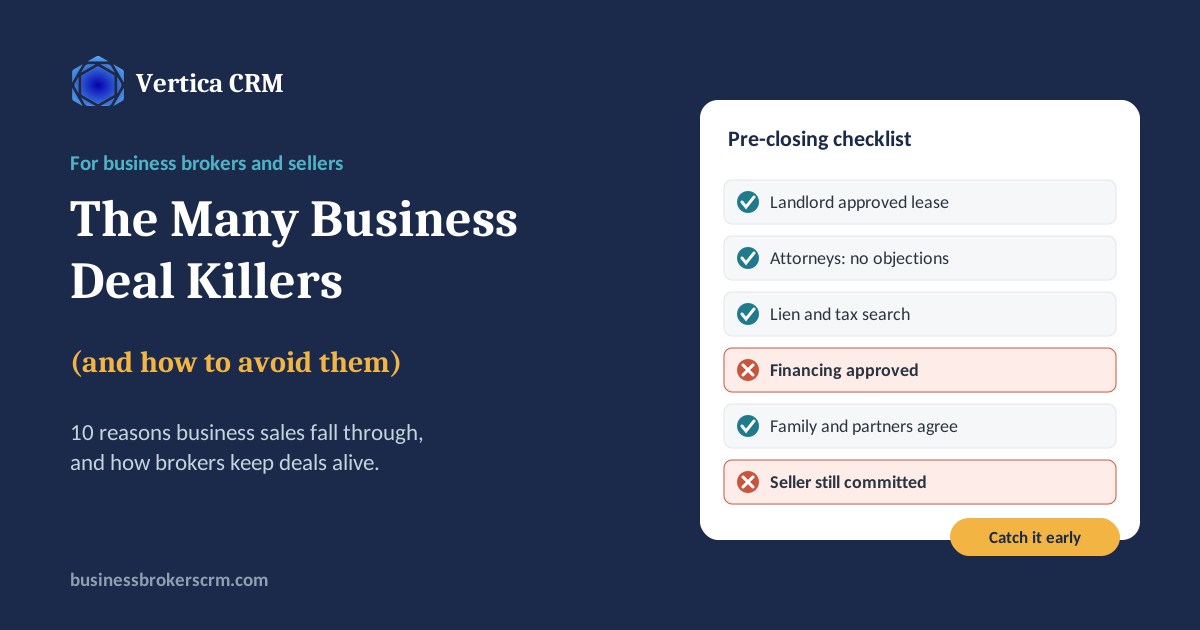
Each stage of a sale has its own risks. Knowing where to look makes them easier to catch:

Common business deal killers by stage of the sale
StageCommon deal killersHow to prevent them
ListingUnrealistic price, unprepared financials, family or partners not consultedReconcile the numbers, ask who has a say, read the lease
Buyer interestUnqualified buyers, confidentiality leaksUse NDAs, approve buyers and qualify them financially
Letter of intentLandlord, advisors or attorneys not yet on boardTalk to every party who can say no before the LOI is signed
Due diligenceFinancial discrepancies, hidden liens, business underperformanceRun lien searches early, keep the seller focused, organize documents in a data room
FinancingLender declines, low appraisalPre-qualify buyers and prepare lender documents
ClosingLate objections, renegotiation, seller's remorseConfirm every party's sign-off in advance and keep the timeline tight
Where business deals die: common deal killers at each stage, from listing and buyer interest to LOI, due diligence, financing and closing
Where business deals die, stage by stage.

A pre-closing checklist to keep deals alive

Most deal killers can be avoided with a frank conversation at the right time. Use this five-step routine on every deal:

  1. Map every player. List everyone who can say no: landlord, both attorneys, accountants, lenders, partners and family.
  2. Talk to each one early. Confirm support before the LOI, not at the closing table.
  3. Check debts and financials. Run lien and tax searches and reconcile the numbers before due diligence.
  4. Track every step. Use stage-based tasks so lease, lien and lender items are confirmed on time.
  5. Keep the deal moving. Watch engagement, follow up fast and keep the timeline short.

Before closing day, confirm each of these:

  • The landlord has approved the lease assignment or a new lease, in writing.
  • Both attorneys have reviewed the final documents and have no open objections.
  • The buyer's accountant and advisors have reviewed the financials.
  • Every partner, investor and family member with a say has agreed to the sale.
  • Lien, judgment and tax searches are complete, and every payoff is known.
  • Financing is approved, and the lender has everything it needs.
  • The seller is still committed, and the latest numbers have been shared with the buyer.

Keep notes on every person involved and every conversation. You don't want to reach the closing table after months of work with nothing to show for it.

A pre-closing checklist to keep deals alive

Most deal killers can be avoided with a frank conversation at the right time. Use this five-step routine on every deal:

  1. Map every player. List everyone who can say no: landlord, both attorneys, accountants, lenders, partners and family.
  2. Talk to each one early. Confirm support before the LOI, not at the closing table.
  3. Check debts and financials. Run lien and tax searches and reconcile the numbers before due diligence.
  4. Track every step. Use stage-based tasks so lease, lien and lender items are confirmed on time.
  5. Keep the deal moving. Watch engagement, follow up fast and keep the timeline short.

Before closing day, confirm each of these:

  • The landlord has approved the lease assignment or a new lease, in writing.
  • Both attorneys have reviewed the final documents and have no open objections.
  • The buyer's accountant and advisors have reviewed the financials.
  • Every partner, investor and family member with a say has agreed to the sale.
  • Lien, judgment and tax searches are complete, and every payoff is known.
  • Financing is approved, and the lender has everything it needs.
  • The seller is still committed, and the latest numbers have been shared with the buyer.

Keep notes on every person involved and every conversation. You don't want to reach the closing table after months of work with nothing to show for it.

How Vertica CRM helps you catch deal killers early

None of this requires special software. But on a busy desk with several deals in progress, it's easy to lose track of who has been called, who has gone quiet, and which task was due last week. We built Vertica CRM to keep track of every player and every step for you, starting with a pipeline view that shows where every deal stands.

Every player linked to the deal

The Relationships tool links everyone involved in a sale to the deal: the landlord, both attorneys, the accountants, the lender, partners and family members. Open the deal and you can see every person who can say no, and every email you've exchanged with them, in one place. (The contact-specific inbox.)

Everything that happens is tracked and logged

  • Inside the CRM: every save, field edit, update and click is logged, so you always know who changed what, and when. Reporting turns that activity into a clear picture of every deal.
  • In the data room on your website: buyer access, logins, logouts, file views and downloads. If a buyer stops opening documents, you'll see it before they stop answering your calls. (The data room advantage.)
  • In the contact's inbox: email opens, clicks and reads, so you know whether the attorney actually read the latest draft.
  • On your website: when a contact views a page, such as the café you just listed for sale, it's recorded on their record. (Business broker websites connected to your CRM.)

The same tracking tells you which broker released confidential information to which buyer, and when. (How Vertica CRM tracks every release.)

Stage-based tasks, so nothing is forgotten

Workflows create tasks automatically as a deal moves through its stages. When a deal reaches due diligence, for example, the system can assign tasks such as confirm lease assignment with landlord, run lien and tax searches and confirm attorneys have no open objections, each with a due date and a reminder. (CRM automation for business brokers.)

And if keeping up with all of it is more than your team can handle, Vertica People virtual assistants can manage the follow-up for you.

Frank conversations save deals

Most deal killers aren't surprises. They're conversations that didn't happen early enough. Talk to the landlord. Ask the attorneys if they have concerns. Find out who else in the seller's family has an opinion. Check for liens. Then keep a record of every step, so that when you finally sit down at the closing table, there's nothing left to discover.

If Tom had done that, the attorney's doubts would have surfaced months earlier, when there was still time to address them, or to move on to a better deal. For more on keeping both sides happy through a sale, see how Vertica CRM takes care of sellers, why the client's interests come first and why no business is too small to deserve your full attention. To fill your pipeline with better deals in the first place, read where your next listing comes from and how to build a referral network. And remember, the real value of a CRM isn't the technology: it's the deals it helps you save.

Catch deal killers before closing day

I'll show you how Vertica CRM links every party to a deal, tracks every step, and creates the tasks that keep deals from falling apart.

Schedule a Demo Questions? Call +1 212 381 4994 (USA) or +61 3 8518 4759 (Australia).

Frequently asked questions about business deal killers

What are the most common business deal killers?

The most common deal killers are lease problems with the landlord, late objections from attorneys or accountants, family members or partners who oppose the sale, hidden liens and debts, due diligence findings, financing that falls through, a business that underperforms during the sale, renegotiation, and deals that take so long that the buyer or seller walks away.

Why do business sales fall through after the LOI?

In Axial's analysis of 65 lower middle market deals that broke after a signed LOI in 2024, the top reasons were diligence findings (21.5%), quality of earnings discrepancies in EBITDA (15.4%), failure to secure financing (13.8%), business underperformance (12.3%) and renegotiation (10.8%).

What percentage of businesses for sale actually sell?

According to the Exit Planning Institute, only 20% to 30% of businesses that go to market actually sell. Preparation, realistic pricing and early attention to deal killers improve the odds.

How long does it take to sell a business?

In the IBBA and M&A Source Market Pulse survey for Q4 2025, advisors reported that businesses typically took six to 12 months to sell, with roughly three to four months of due diligence after a signed LOI. Every extra month gives a deal killer more time to appear.

How can a landlord kill a business sale?

Most small business sales depend on the buyer taking over the lease or signing a new one. If the landlord refuses to assign the lease, raises the rent or changes terms, the buyer may walk away. Brokers should talk to the landlord early and confirm the assignment process before the LOI.

How do you prevent a business sale from falling through?

Identify everyone who can block the deal and talk to them early, check for liens and reconcile the financials before due diligence, keep the seller focused on running the business, protect confidentiality, follow up quickly, and track every task and conversation so nothing is missed before closing.

How does a CRM help prevent deal killers?

A business broker CRM such as Vertica CRM links every party to the deal, logs every action and conversation, tracks data room activity and email engagement, and creates stage-based tasks such as confirming the lease assignment with the landlord, so problems surface early instead of at the closing table.